Replay
Rental lead manager: ranked call desk
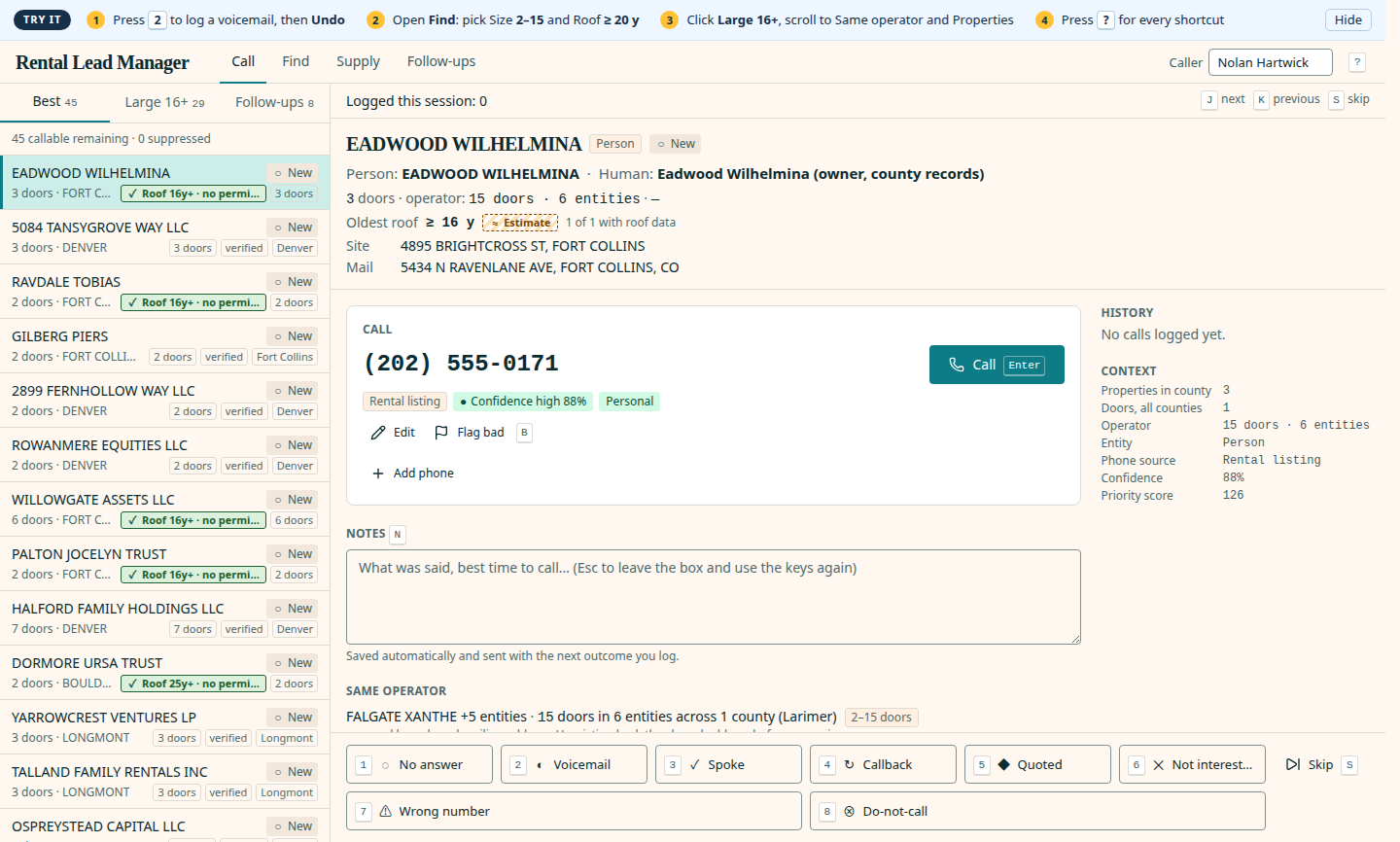
A call desk in one HTML file of about 700 KB, where keys 1 to 8 log an outcome.
For teams that prospect property owners: one county record, one AI web-search request, and a phone candidate saved only with its source URL, held for review. Built and deployed 29 to 30 Oct 2026.
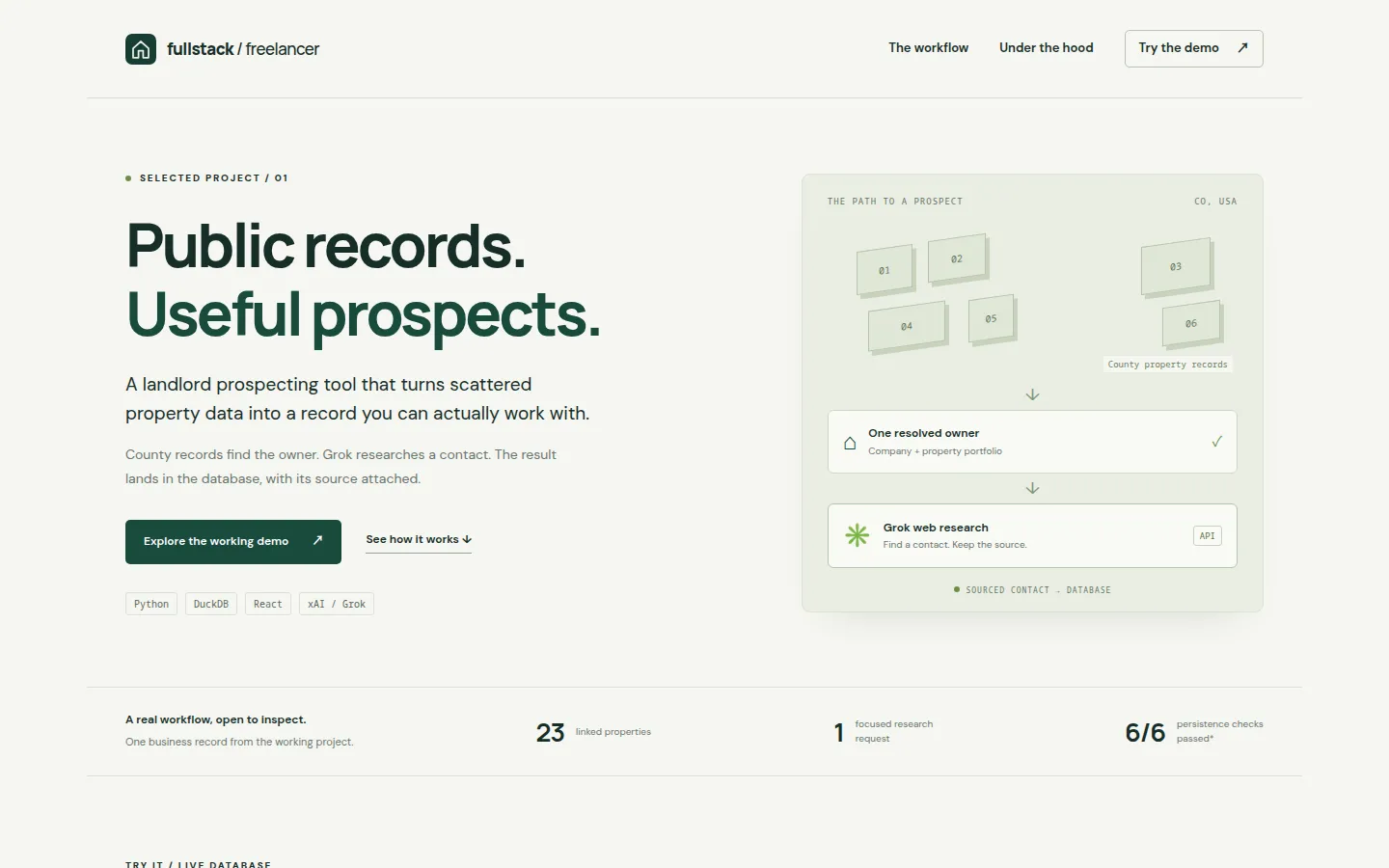
A county record names an LLC, and there is no phone number to call. We built the step in between. One press asks an AI with web search for the business's phone number and saves it only with its source.
This is a live demo on its own server, with one real public record. Further down, a replay walks through the larger project's call-list pipeline.
One real Colorado company's public record, with 23 linked properties, produced a phone candidate with its cited source. The run is recorded in the deployed evidence and took the saved contacts from 0 to 1.
On the run, the model stated 0.9 confidence and explained why it set aside a contact person's number; that reasoning stays in the research text. The contact lives in a separate DuckDB outside the release, and the contact and its attempt survived a restart.
The request allows at most 3 tool calls and 1,800 output tokens. It tells the AI service not to keep the response (store set to false) and times out after 120 seconds. The default model is grok-4.7. [xAI Responses API]
    try:
        r = req_lib.post(
            API_URL,
            headers={"Authorization": f"Bearer {api_key}", "Content-Type": "application/json"},
            json={"model": MODEL, "input": prompt, "tools": [{"type": "web_search"}],
                  "max_tool_calls": 3, "max_output_tokens": 1800, "store": False},
            timeout=120,
        )
        r.raise_for_status()
        data = r.json()
        if data.get("error") or data.get("status") == "incomplete":
            raise ValueError("Grok did not complete its research response")
Two small tables hold the contacts and every attempt. [DuckDB]
        con.execute('''CREATE TABLE IF NOT EXISTS owner_contacts (
            phone VARCHAR PRIMARY KEY, owner_id BIGINT, source_url VARCHAR,
            sourced_at TIMESTAMP, status VARCHAR DEFAULT 'unverified')''')
        con.execute('''CREATE TABLE IF NOT EXISTS grok_research_attempts (
            attempted_at TIMESTAMP PRIMARY KEY, status VARCHAR, research VARCHAR,
            source_url VARCHAR, model VARCHAR, added INTEGER DEFAULT 0)''')
The page is plain JavaScript on a Python standard-library server, with no build step. [Python, DuckDB 1.5.2, requests 2.32.5]
This demo runs the research step and its storage on one real Colorado company and its 23 linked properties. The prompt is fixed on the server, so the AI service only ever sees the server's own request. County feeds, registry matching, listing scrapers and the React interface belong to the larger project.
Replay
A call desk in one HTML file of about 700 KB, where keys 1 to 8 log an outcome.
Replay
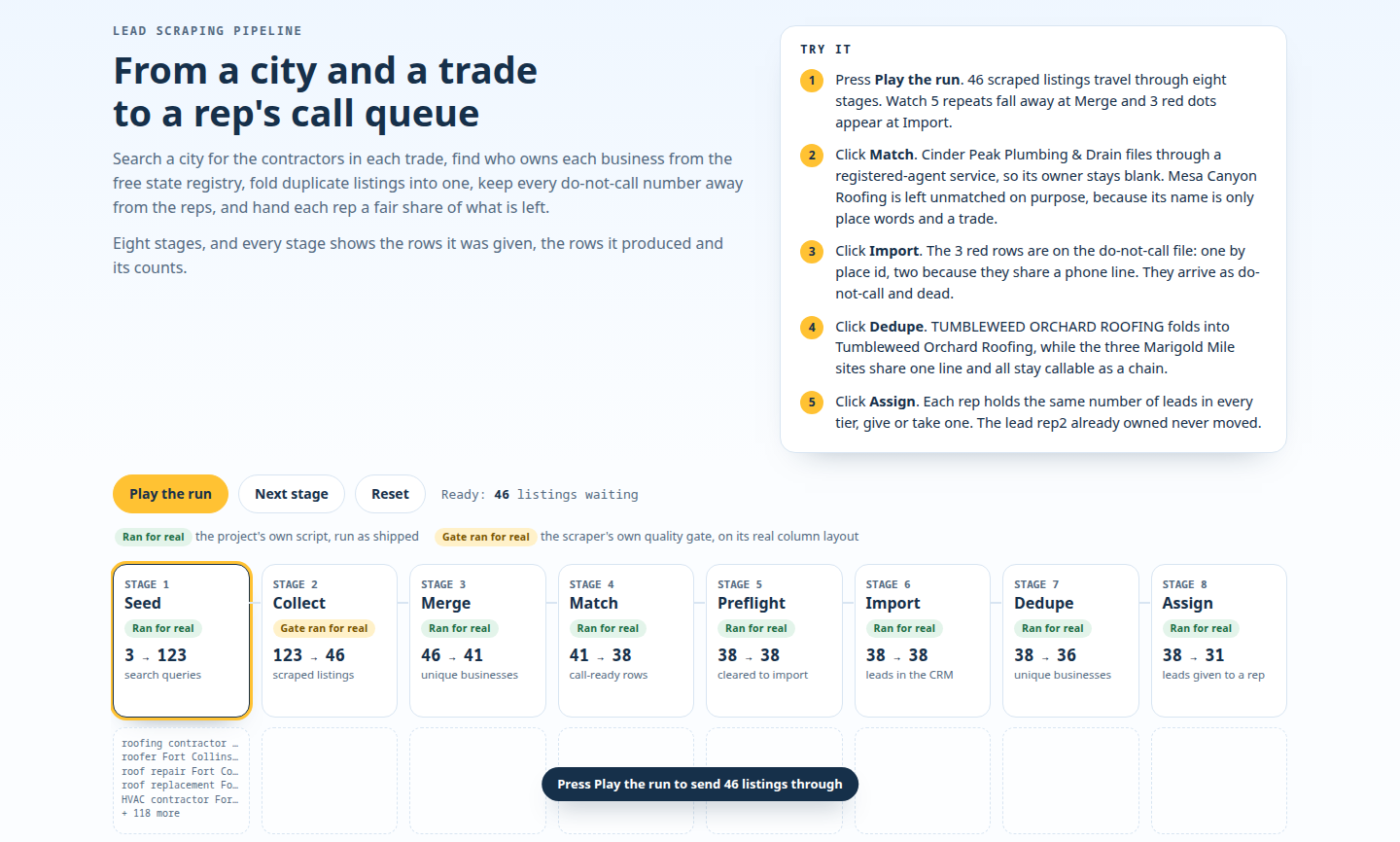
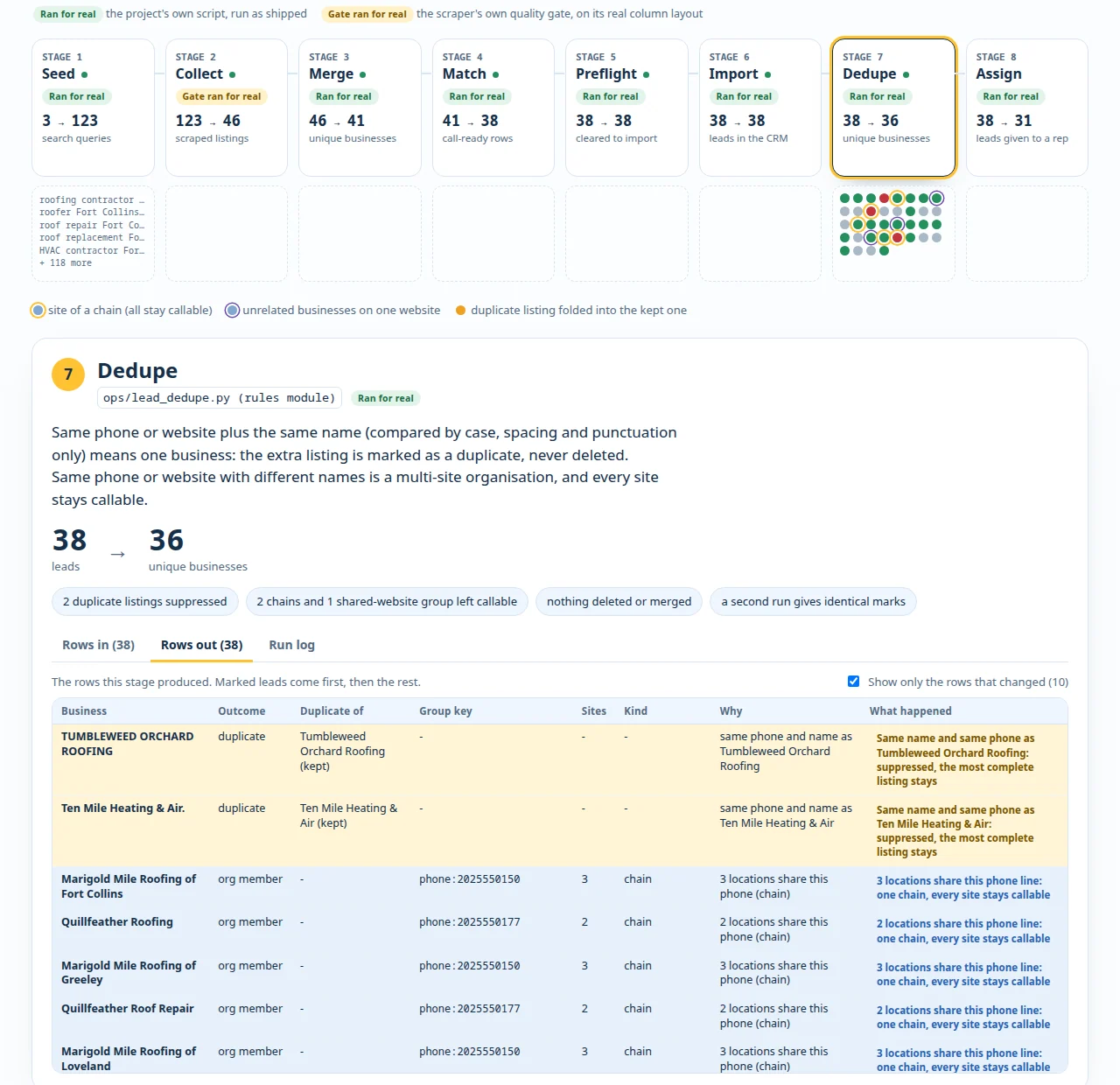
A real run, replayed: the eight-stage call-list pipeline, played back stage by stage.
The county records behind the larger project: 3,361,791 raw rows became 1,391,184 parcel records, one per piece of land, from nine county sources.
Every phone candidate arrives with its cited source, so your team checks it before outreach.
The day's allowance is reserved before the paid call and survives a restart or an error.
The service accepts same-origin POST only, with no body and a 1 KB limit at the web server. Under systemd it runs with no new privileges, a strict file system and a 512 MB memory cap. The release holds no keys, original databases or owner lists, and the original app's database and six source files were not changed.
The larger project stops collecting public data the moment a source refuses, and never retries. [HTTP 403]
Tell us which public records you use and what contact information you need. Include where you would review each candidate's source.